
Within: Worlds We Build, Truths We Synthesise | The Art of Bunmi Agusto
In an interview with GIDA, Agusto unpacks the intricacies of world-building, the role of intuition and flatness in her practice and the diverse influences that have molded her evolving canon of storytelling.
Interview by Oluwakemi Akinrele
Writing by Saidat Animasaun
Images courtesy of Bunmi Agusto
October 2025
World builder, Bumni Agusto is a multidisciplinary artist, writer and curator who is fueled by a deep infatuation with fantasy and magical storytelling. Born and raised in Lagos Nigeria, and informed by her Yoruba, Edo and Afro-Brazilian descent, Agusto, draws on her interwoven heritage while asserting an approach she calls natural synthesis - a refusal to prioritise one cultural paradigm over another, instead allowing each to carry equal weight.
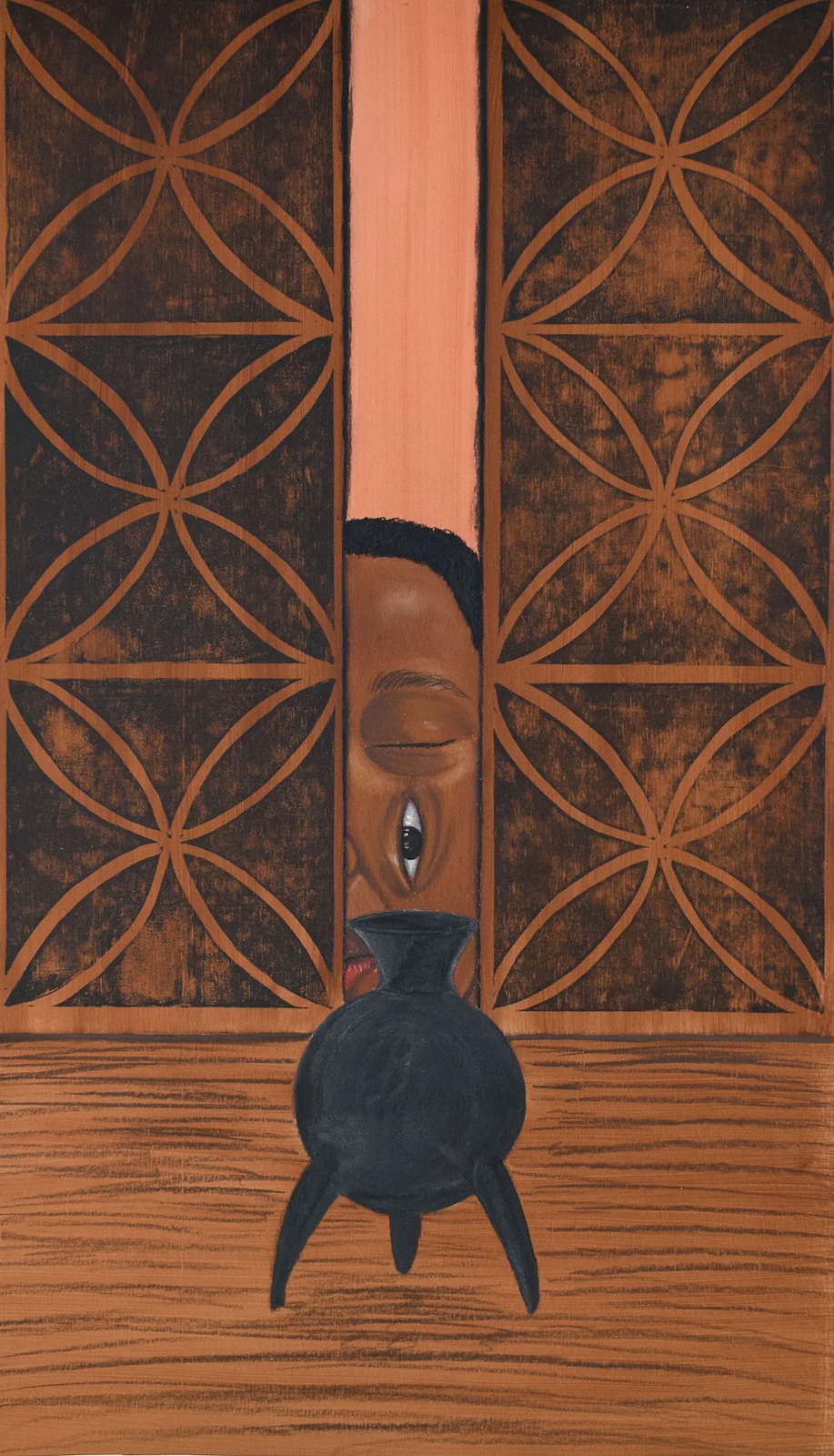
At the core of her practice is Within, a vast universe that she has developed as both a macro-reflection of her own interiority and a living archive of everything she encounters in her ‘walking life’. In the threaded landscape of Within, Agusto depicts the ‘otherworldly, allegorical’ lives of humans, eight hybrids, a representation of herself formed as a compound of past lives and ancestral coding, amongst ghosts and other inhabitants. “My point in often bringing up natural synthesis is that I simply depict my truth…My work is born from my sense of self, which is very complex on its own and I think people are sometimes excited by my work because they can sense that shared complexity,” Bunmi Agusto shared.
In an interview with GIDA, Agusto unpacks the intricacies of world-building, the role of intuition and flatness in her practice and the diverse influences that have molded her evolving canon of storytelling.
GIDA: Your practice visualises your imagined world Within, the characters that inhabit it, and you - who you’ve mentioned you consider a visitor or trespasser. You’ve mentioned how this world has long existed as a part of your psyche, but in one of your interviews, you discussed your interest in Uche Okeke’s theory of natural synthesis, which called artists to fuse indigenous and western artistic influence to form a uniquely ‘modern’ Nigeria art. Besides your own imagination, what other influences, historical, contemporary, visual or literary, inform the way you synthesise your storytelling?
Bunmi Agusto: Ultimately, I am very interested in abstract ideas and concepts and those end up being encased in various forms. It could be in fashion, video games, art. So consequently, I have a very wide range of influences and I try not to discriminate. From the Marvel Cinematic Universe to adire dyeing practices to the work of Caravaggio to the work of Twins Seven Seven, to Ruby Amanze, to Octavia Butler, to Christopher Nolan, to The Legend of Zelda.
My point in often bringing up natural synthesis is that I simply depict my truth. I am not trying to make art that represents a singular overarching idea of my Nigerianess –for example– and fall into the trap of pretending there are little or no external influences at play. My work is born from my sense of self, which is very complex on its own and I think people are sometimes excited by my work because they can sense that shared complexity.
Due to colonialism and the general formation of Nigeria as a nation, there is a lot of Britishness entrenched in Nigerianness. I attended schools with British curriculums. The media on television I watched growing up was primarily American. My approach is about simply not ignoring one cultural paradigm for the other; it’s about treating things with equal weight and respect and finding the commonalities between things. I like to compare The Palm Wine Drinkard and Alice in Wonderland, Yoruba mythology and Ancient Greek mythology, The Matrix and Matilda. I simply depict the truth of the concoction of influences that inform my interior world.
An important distinction Nnedi Okorafor makes between Afrofuturism and Africanfuturism is their relative temporal focuses. Where afrofuturism concerns itself with ‘what was’ and decidedly reclaims the past to rewrite it as ‘what could have been’, Africanfuturism takes the actuality of ‘what has been’ and looks at ‘what could potentially be’. What, if any, are the temporal boundaries you place on your imagined world? Do you see it as having a past/ future axis, for instance, or like Grace Dillion’s definition of the native slipstream, a set of “pasts, presents, and futures that flow together like currents in a [...] stream”?
BA: Within is essentially a fantastical retelling of my life, so it functions as the present in that sense. However, there is also a predictive quality to Within. In my oeuvre, there are some works that are more consciously thought out and decided and some that are more instinctive and change the direction of critical thought in my practice, e.g. Displacement Under A Full Cowrie (2022) signalling my shift from focusing on migration to spirituality. There have been several uncanny moments where the instinctive works have somehow predicted what was coming next in my life and what themes would become my focal point.
For me, that begs the question of if intuition is a product of the divine eternal essence within each individual –such as the orí in the Yoruba conception– that exists outside of linear time. In that sense, the present is simply a moment of consciousness. Is déjà vu a product of time travel of one’s consciousness? Is remembering time travelling? Time certainly has its way of looping and crossing in on itself in a complex manner.
In your introductory essay for your substack, you stated “it is one thing to create characters” and “another thing to build them in a world”. Given the constraints of working within a legacy franchise like Doctor Who, did your own worldbuilding practice in Within shape how you approached the project? Are there any tangible or conceptual parts of your world we can see manifested visually in the episode?
BA: For a long time, Within came to me very intuitively. It still does, but my long-term process often involves allowing my subconscious or intuition to make a seemingly random work that I feel compelled to make, then I spend at least a body of work trying to understand what I had created and why I created it. For example, Displacement Under Two Cowries came to me in a dream, so I had to decipher it and understand that it featured a character falling between two planes of existence. That is when I started to ask questions that have now led me to several bodies of work exploring the metaphysical. So I would say that is how that world-building skill has been built over time.
I’ve recently started calling myself a world-builder because I’ve done more consulting now that I’ve built the skill. I’ve now done consultation on puppet design for theatre, research for the Nigeria Pavilion at the London Design Biennale, even back in 2021 when I painted on Aso Oke for Kenneth Ize’s fashion show at Palais de Tokyo. With regards to Doctor Who, the role I played in creating art for The Story and The Engine did not require too much world-building on my part because it is Inua Ellams that wrote the episode. I simply had to respond to his text with the visuals that came to mind. Therefore, yes, you can definitely see the visual language I have established for Within manifested in the episode. Some examples are the borders that often segment me compositions and the mixed-media combination of drawing, painting and printmaking.
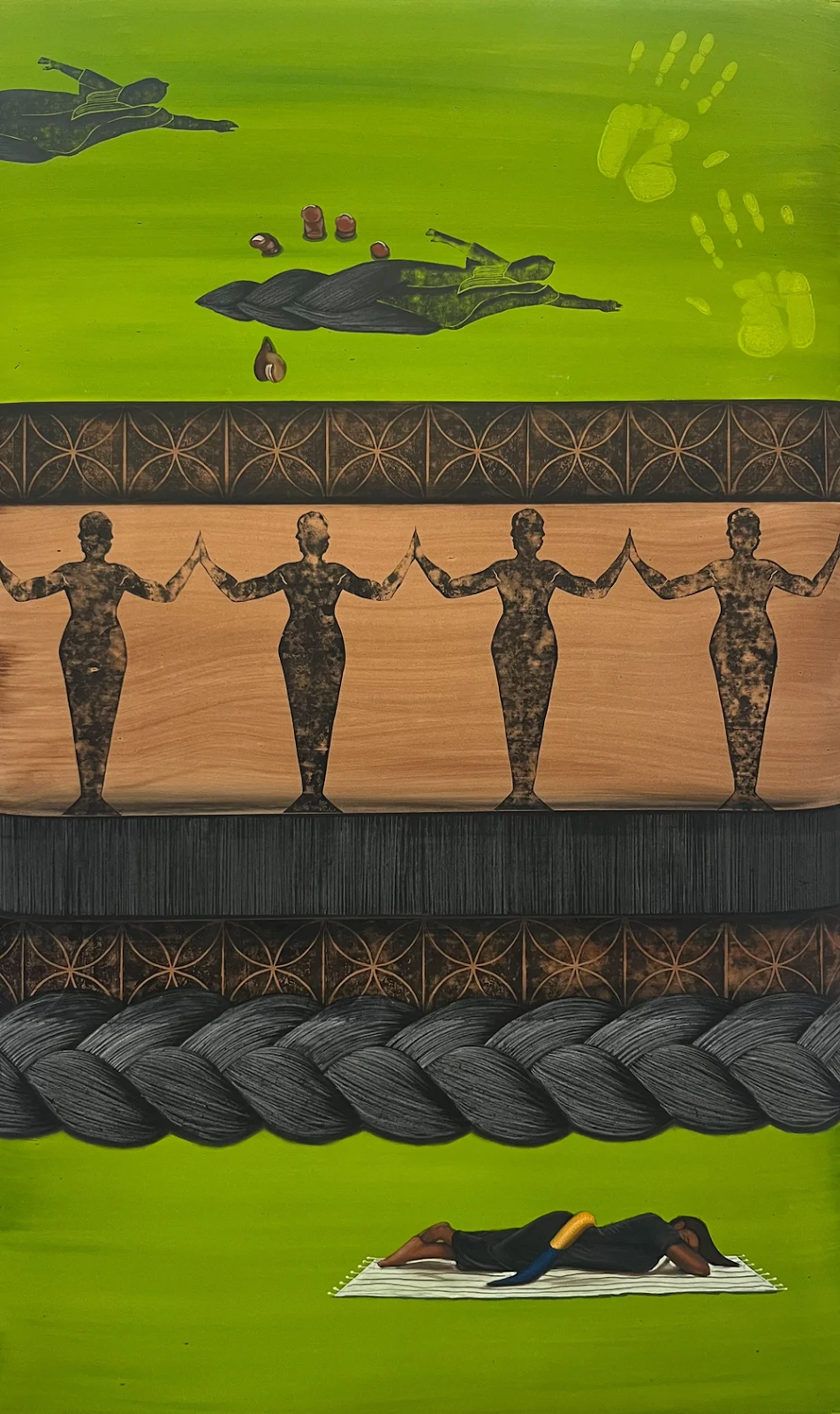
Do the figures in Within represent specific individual characters or are they used as signifiers of your feelings and stories?
BA: The key figures in Within are: myself, Olubunmi; Ó; the eight hybrids; and the humans. I represent myself as both a vessel and documentor of this world. Ó represents my orí –the ancient, complex, divine essence within me that resides in each individual. The eight hybrids were planted by Ó by combining a strand of my hair with theirs. The hybrids were thus born in my image, but Ó’s genetics triggered unique mutations in each of them that affords them magical abilities. They each also represent a fragment of my persona. The humans are people from my waking life as Olubunmi who have been pulled into my internal world by interacting with me. Family members, friends and passersby therefore become cross-reality migrants in Within.
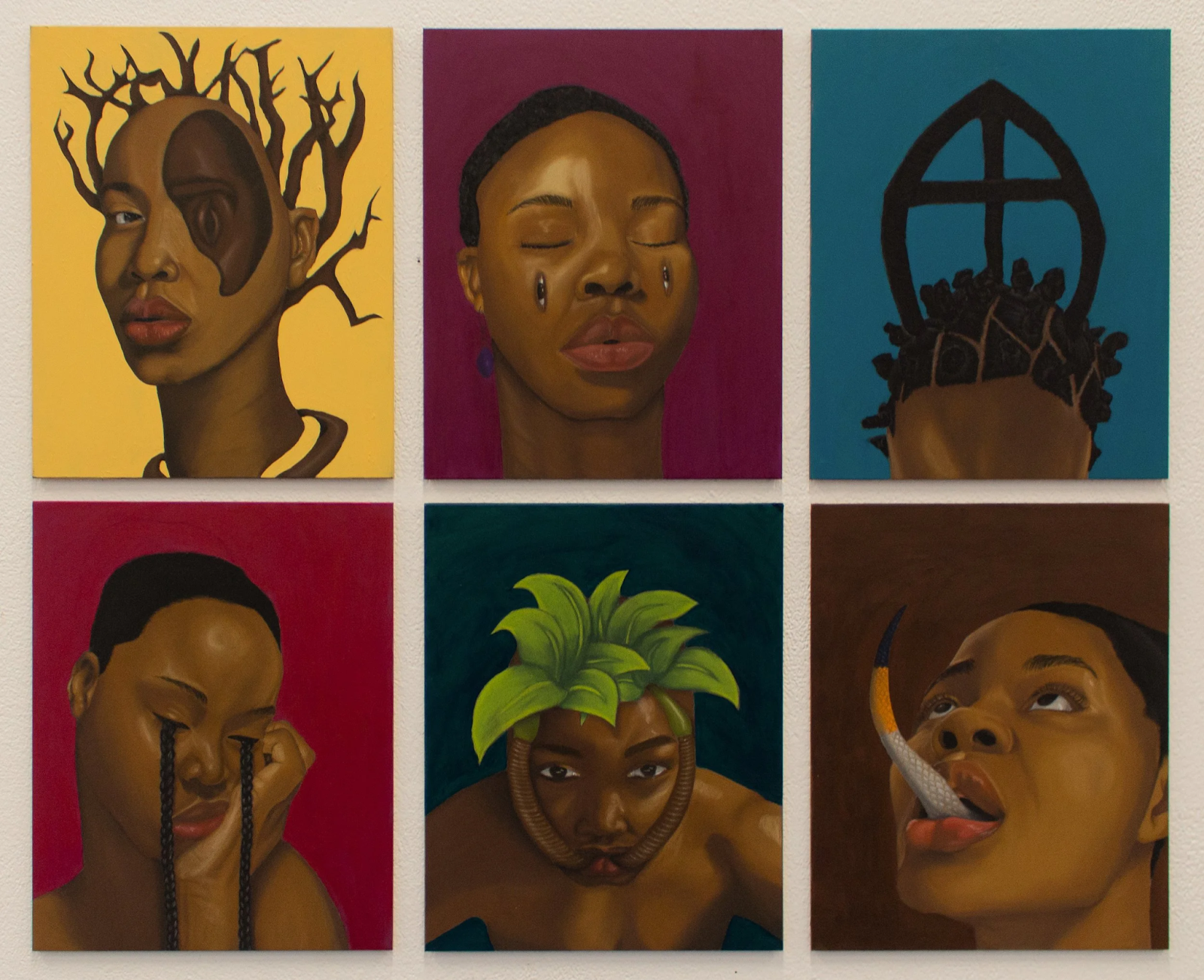
The eight hybrids are Umbanda, Aruaro, Irunoji, Iroko, Arecale, Ijapa, Agama, and Elfe. Umbanda was born with skin prongs that extend from their scalp to form the shape of the cross above their head. They have the power of clairvoyance and thus the spiritual guide for inhabitants of Within. Aruaro was born with a second set of eyes nestled between the tribal marks on her cheeks. With these eyes, she can see ghosts and apparitions. Irunoji has braids coming out her eyes and she has the ability to telepathically manipulate the hair embedded in the landscape. She is thus the architect, artist and maker in the world. Iroko is named after the infamous tree in Yorubaland believed to be inhabited by a powerful spirit. This is because Iroko’s mutation is tree-like branches extending from her scalp and flowering into an afro. She has psychometric abilities, giving her the ability to read the history of an object simply through touch. She is a collector and historian. Arecale and Ijapa are twins born from the same cocoon. Arecale has palm-tree tusks and embodies impulsiveness and aggression, whilst Ijapa was born with a tortoise shell and is more defensive and patient. The fact that they are twins alludes to each balancing the other out. Agama was born with the tail of the Agama lizard and has the ability to stretch her limbs like Mr Fantastic. She represents the chill, laidback side of me and you can often see her lazing and napping in works like Reaching Through Worlds (2023). The youngest is Elfe who is a musical nymph with leaf ears and palm-wings who has the ability to make trance-inducing music.
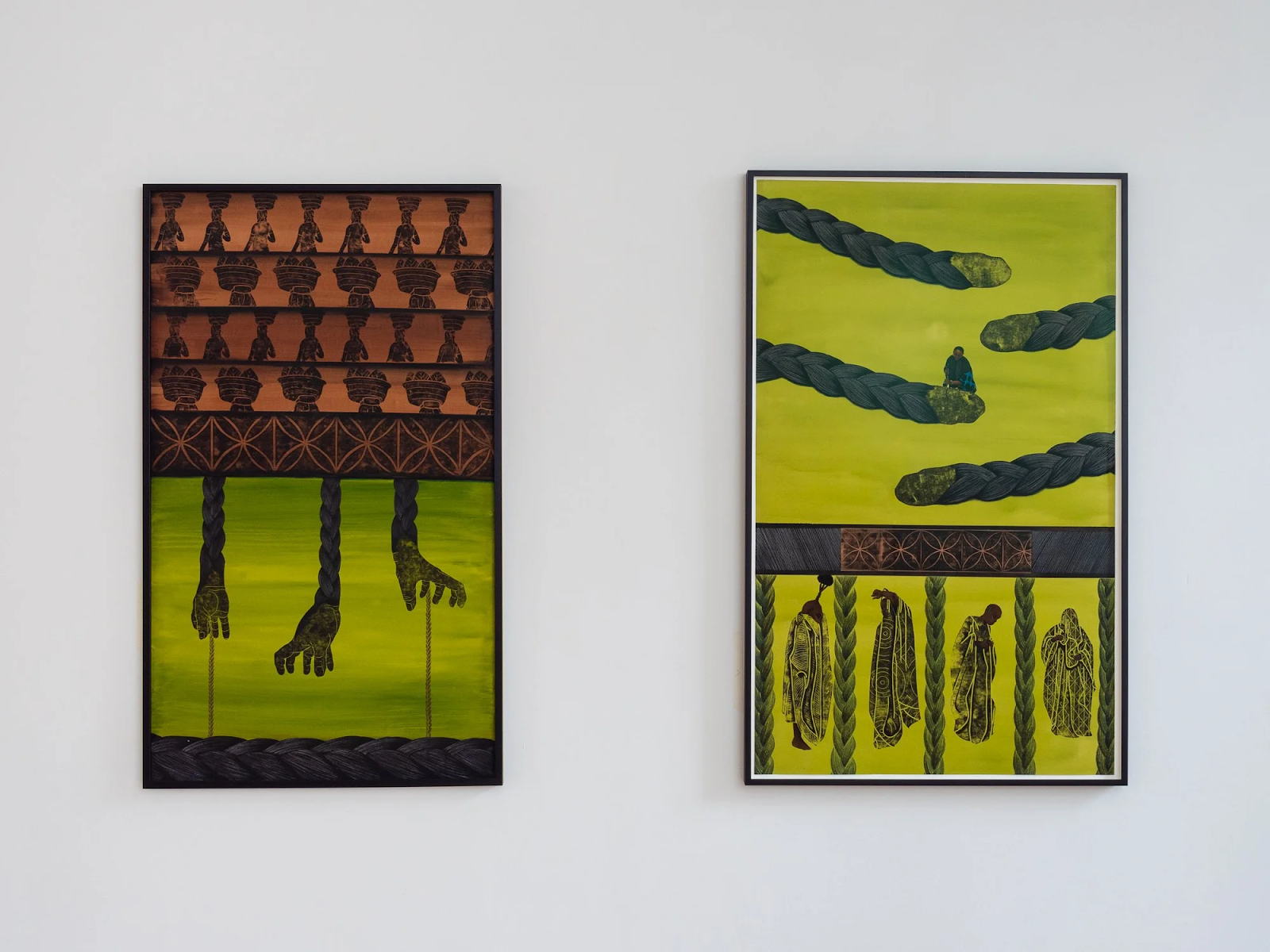
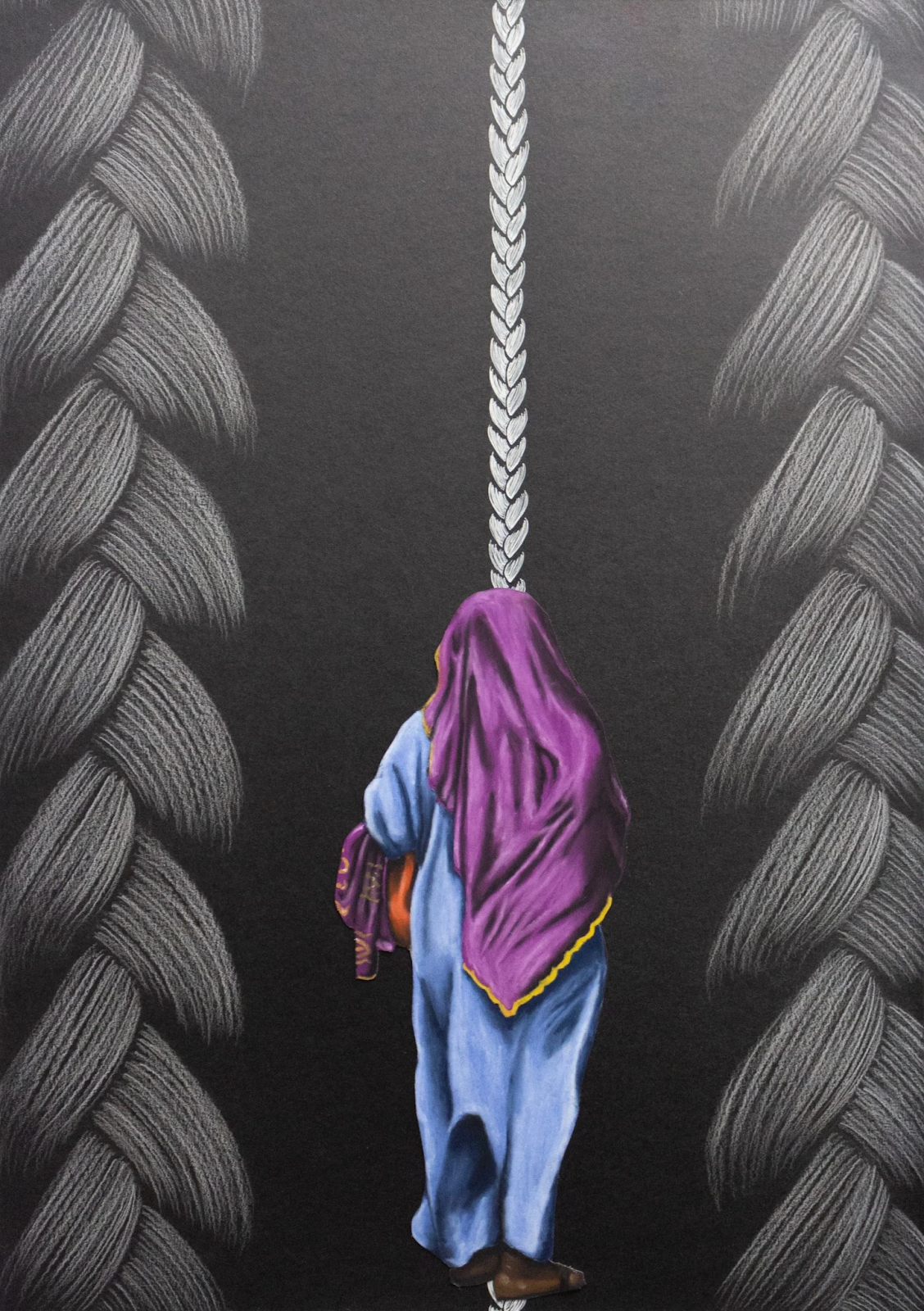
During a study abroad at the Hague, you mentioned you worked mainly digitally to make moving around more convenient. How do you think materiality affects viewers’ engagement with your work? Is something lost or gained when you migrate an idea across media, or do you reserve certain image types for certain materials and scales?
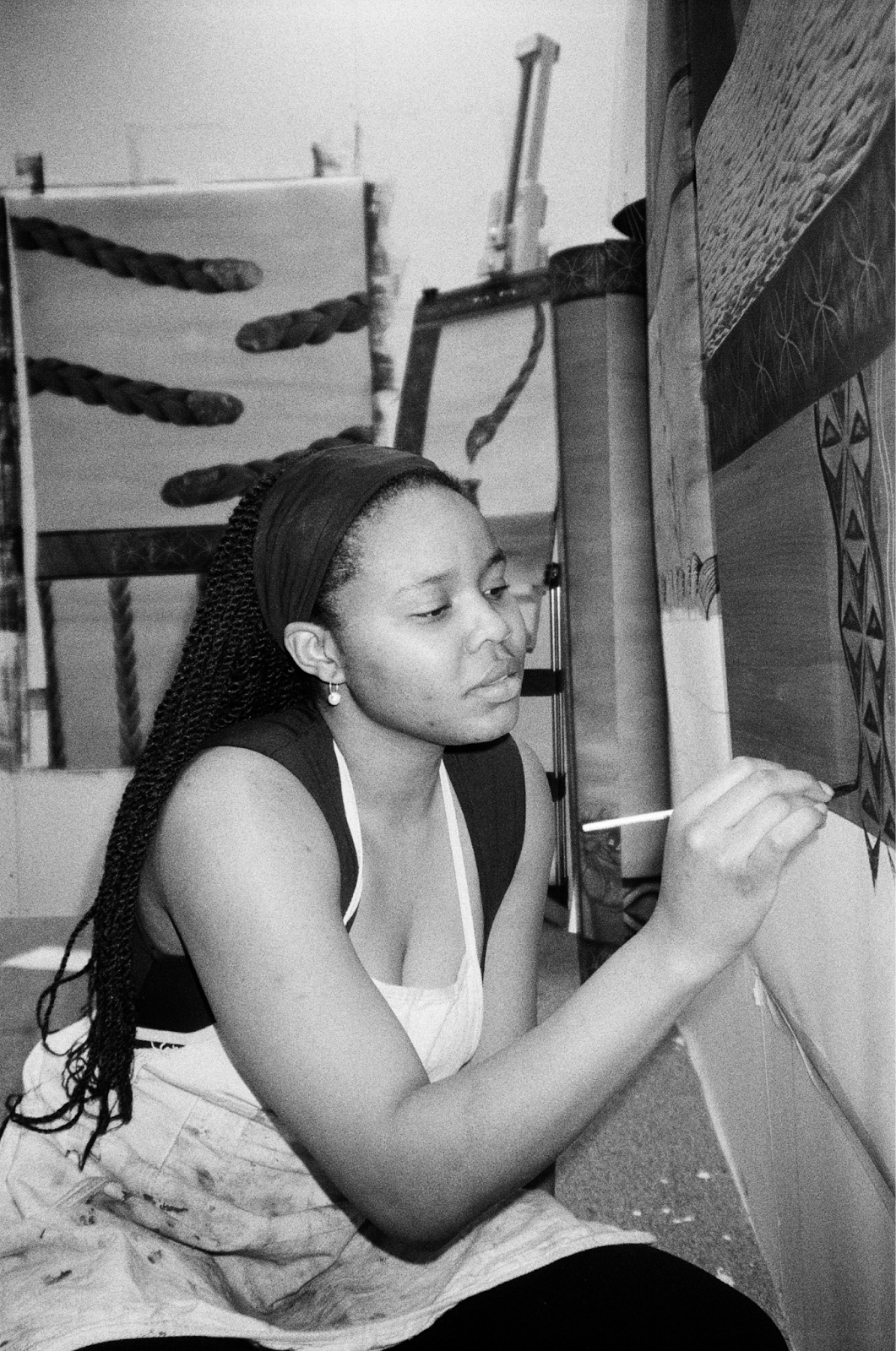
BA: An underrated but important aspect of my practice is flatness. That has been key in my being able to shift between digital and physical. During my time at the Royal Academy of Art, The Hague (KABK) in 2018, I learnt to use Procreate on the iPad as well as video editing software such as Adobe Premier Pro and After Effects. So with these skills, I started making moving image works that were essentially digital collages of what I had drawn both physically and digitally.
Then years later, by 2021, my work was primarily collage, again with elements I had drawn as opposed to existing found images. Back then, I used to draw my figures on fine sandpaper because its bite held the chalk pastels much better than ordinary paper or canvas ever would, then I would insert these chalk figures into drawn landscapes on paper. I finally found the sanded pastel paper I work on today in 2022 with the first exhibition of the resulting works being The Spectacular Mundane of Within at 1-54 Contemporary African Art Fair, London. Even though I have now moved on to a sanded pastel paper that can handle painting, printmaking and drawing, I still compose my works like a collage of flat elements.
Additionally, that flatness is a nod to ancient modes of storytelling and documenting, e.g. the Egyptian hieroglyphs, the Greek. This form of storytelling and world-building on a two-dimensional plane is also evident in video games like Super Mario where one sees the characters moving across the screen. This framework is also deeply philosophical in that the two-dimensional nature of the works highlights our three-dimensionality as a “higher realm” that rules over theirs and I am the auteur of the artworks. It is all very meta.
I think there can be something lost when migrating an idea across media if you do not know your practice in and out. It seems like an easy thing from the outside, but as an artist, truly knowing your practice can be very elusive. It’s a process. There are times when artists such as Tschabalala Self and Michaela Yearwood-Dan have done a gear shift between media in their careers and it has been really exciting, but that skill and knowing comes with time. Also, one simply needs time and support to develop a new skill set with new tools.
I’ve also noticed you sometimes share preliminary drawings of your work - these illustrations are sometimes accompanied with writing, other times they are annotated, or paired with a mind map. Do you feel a responsibility over the way viewers understand / engage with your work?
BA: People often ask me if I make detailed preliminary sketches of each work because they perceive my works as extremely precise. The answer is no, not really. At best, I have a thumbnail-like sketch with stick figures and annotations in my notebook. I probably prioritise the research and development first, then allow what is actually put on the paper to be guided by intuition –but an intuition armed with very intentional research. I spend way more time researching than making. My essays are basically my sketches in a way.
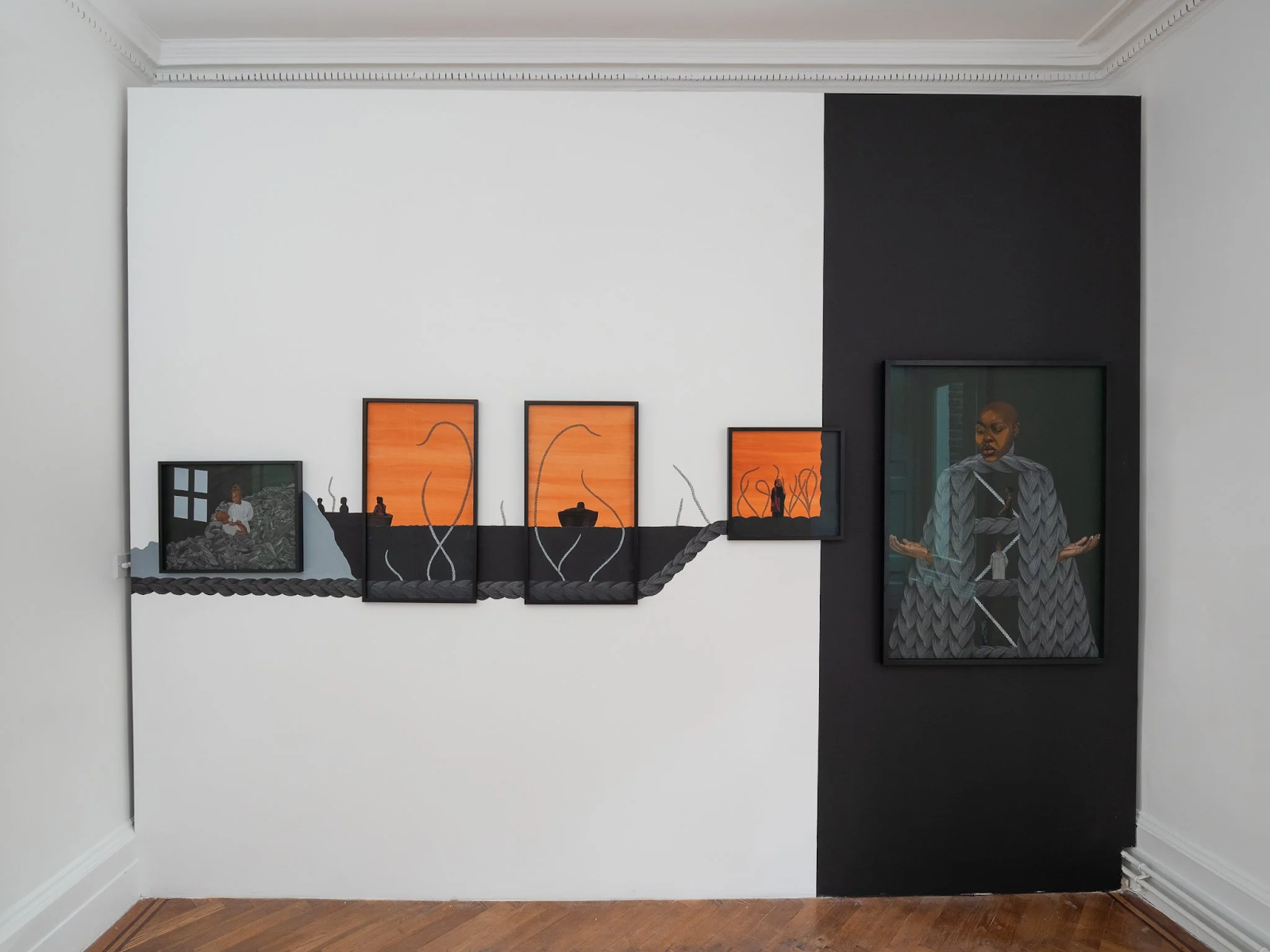
With regards to viewers understanding my work, I wouldn’t say I feel a “responsibility” per se, but it is definitely something I think about and play with from exhibition to exhibition. In some shows, I exhibited blown up versions of my mind-maps on the walls. In some, I have tried to create a bit more of an immersive storytelling environment. In some, I just let the exhibition text do its thing, but I have also written almost all of my exhibition texts myself. The current most effective solution has actually been my Substack, which I love very much. There are some months I’d much rather be researching and writing than drawing. These essays have become the most legible seminal texts in terms of viewers having a better understanding of my practice.
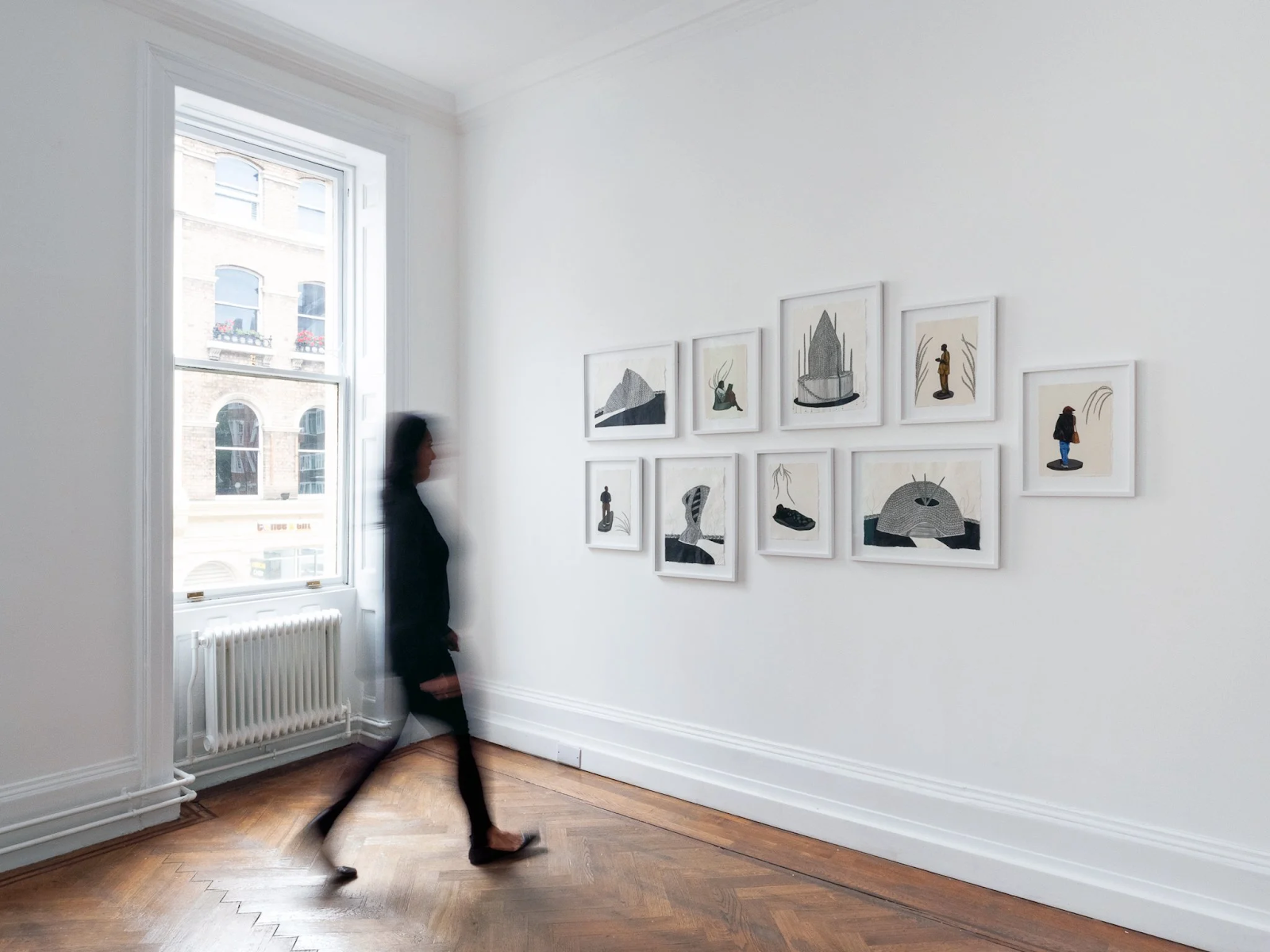
In your new exhibition Clouds Never Die at TAFETA Gallery, you explored feelings of loss and grief - please could you share more about the process of creating this body of work and how it may have differed to others?
For this body of work, as well as Lands of the Living, I became a student of comparative mythology. This is the study of myths from different cultures, looking for shared themes, structures, and origins. It aims to understand the commonalities in human experiences and cultural expressions across various societies through their mythologies. I specifically looked at structures of the cosmos across various countries, asking questions like “Is heaven always situated above in a higher realm?” and “What matter functions as the border between realms?”, in creating my own spiritual framework for Within.
Both exhibitions were produced after suffering the loss of a loved one, thus triggering my fascination with the afterlife and the unseen. I created Lands of the Living after my father’s passing. I lost a very dear friend Olaoluwa Daranijo and my grandfather Eugene Olotu during the making of Clouds Never Die. I am making a point to say their names because the Ancient Egyptians say: “—.” So one of my grieving practices that brings me some comfort is saying their names frequently because it makes me feel like they are living on longer and not being forgotten. May their souls rest in perfect peace.
Doing the research and making these works have certainly been a huge part of my grieving process.
GIDA © 2025